RV Window Replacement Cost: What to Expect in 2026
RV side window replacement costs $80 to $1,500 installed depending on window type, size, and whether you need glass only or a full assembly. Here's what each type actually runs.
Typical cost
$80–$1,500
Most owners pay $80–$300 DIY or $350–$900 installed; dual-pane and egress windows push higher
Most people pay around
$425
Costs verified June 2026
Most RV side window replacements cost $80 to $350 in parts if you handle the swap yourself, or $350 to $900 installed at a shop. That wide spread comes down to window type. A basic jalousie or slider assembly off a parts site like RecPro costs $115 to $190. A large frameless or dual-pane unit runs $250 to $600 in parts before any labor enters the picture. Egress emergency-exit windows, which require size and a specific push-out latch, land at $600 to $1,500 installed.
The windshield is a different job handled on its own page. This covers everything on the sides and rear of the coach.
What type of window do you actually have?
Getting the cost right starts with identifying the window type, because sourcing and installation vary by design.
Jalousie or louvered windows use horizontal glass or acrylic slats that rotate open on a crank mechanism, similar to exterior shutters. They provide strong ventilation and were the default on many travel trailers and fifth wheels built through the 1990s. The mechanism, not the glass, is usually what fails first. A full jalousie assembly replacement runs $165–$400 for parts. The slats themselves cost $50–$150 for a standard set, and the crank operator runs $50–$150 separately. Jalousies seal poorly compared to modern windows, which is why newer builds have largely moved away from them.
Sliding windows are the current standard. A framed panel moves horizontally in a track, usually with a screen on the interior side. They come in dozens of standard sizes from suppliers like RecPro and Hehr. Parts pricing is predictable: $115 to $190 for most catalog sizes (12x18 through 30x20 inches), with a simple exterior-screw removal and butyl-tape rebed being all the installation requires.
Teardrop-style windows are a marketing term used by some suppliers (RecPro uses it) for compact slider assemblies with rounded corners, popular on teardrop and smaller A-frame trailers. Mechanically they are sliders and follow the same pricing.
Frameless or radius windows have no visible exterior frame, sitting flush with the sidewall. They require more sealant work and tighter tolerances than a standard framed unit. RecPro’s frameless catalog runs $165 to $260 for standard sizes, up to $259.95 for a 24x36-inch panel. Non-standard corner radii require custom fabrication and can push parts costs to $400–$900 for the glass alone.
Dual-pane or thermopane windows use two glass panes with a sealed air gap for insulation. They are standard on newer coaches and most Class A and Class B motorhomes. When the inter-pane seal fails, condensation builds in the gap and the window fogs from the inside. Full assembly replacement costs roughly double a single-pane equivalent: $250–$600 in parts, $450–$900 installed.
Emergency-exit egress windows are large push-out panels installed in sleeping area walls. NFPA 1192 sets minimum size requirements for certified RVs, and the push-out latch must function without tools. RecPro stocks 30x22-inch and 36x22-inch egress assemblies at $230–$235. Installed costs run $600–$1,500 because of the opening size, required sealant work, and the safety-compliance stakes.
Cost by window type
| Window type | DIY parts only | Installed at shop |
|---|---|---|
| Jalousie (full assembly) | $165–$400 | $350–$700 |
| Single-pane slider | $115–$190 | $300–$650 |
| Frameless / radius | $165–$260 | $500–$900 |
| Dual-pane / thermopane | $250–$600 | $450–$900 |
| Egress / emergency exit | $230–$235 | $600–$1,500 |
| Glass-only (owner removes frame) | $80–$200 | $250–$500 |
DIY parts prices based on RecPro catalog and RV Upgrade Store data, verified June 2026. Installed prices reflect $159–$225/hr shop labor plus 1–4 hours depending on window type.
The foggy dual-pane problem
A window that has gone cloudy from the inside is not a glass crack. The inter-pane seal has failed, usually from age or the repeated thermal cycling of a coach heating and cooling season after season, and moisture entered the air gap. The glass itself may be fine.
If the fogging is recent and the glass is not etched or scratched on the interior face, a reseal is worth trying first. The RV Geeks documented a complete DIY kit for roughly $125, which includes the reseal compound and enough seal strip for around 10 window perimeters. The process takes 2–4 hours per window: carefully separate the two panes, clean both interior faces, apply new desiccant, reseal with new butyl or silicone, and reassemble. It requires patience but no specialized tools.
If a shop does it, expect $200–$300 per window for remove, reseal, and reinstall. That math changes once you have more than two fogged windows, because a DIY kit that handles 10 windows costs less than one professional reseal.
The case for full replacement: if the glass has been etched from long-term moisture contact, a reseal clears up the seal failure but leaves permanently cloudy glass. No amount of cleaning fixes etching. At that point the assembly needs to go.
Glass-only vs. full window assembly
Replacing the full assembly including the frame is the default approach because it ensures you get a clean new seal and fresh hardware. But if the frame is undamaged and the issue is just the glass, glass-only replacement costs significantly less.
Specialist suppliers cut RV glass to pattern. Wise RV Glass (wiservglass.com) and Lippert/Duncan Systems are the main sources for OEM-spec panes. A single-pane cut to size runs $80–$200. A dual-pane insulated glass unit (IGU) cut to the same opening costs $150–$400 depending on size.
The owner handles frame removal, ships or brings in the old glass as a template, and receives the cut pane. Many owners have completed this job without touching a service center. The limitation: if the frame or its mounting channel is deteriorated, you’re also doing frame work, at which point a full assembly swap usually makes more financial sense.
DIY window replacement: how it actually works
Most framed RV side windows are installed the same way regardless of brand: screws through the exterior trim ring hold the unit against a butyl tape bead applied to the wall opening. To swap one out, you remove the exterior screws, pull the old assembly, scrape the old butyl tape from both the opening and the frame channel, apply fresh tape, press the new unit in from the outside, and run the screws back in. Self-leveling lap sealant around the exterior seam finishes the job.
Butyl tape runs about $16 for a bulk roll, and a tube of Dicor lap sealant is around $15 to $20. Total consumable cost per window: $30–$65.
Where this process gets harder:
- Frameless flush-mount windows have tighter tolerances and more sealant work. A gap that would be covered by a trim ring on a standard window is visible on a frameless unit.
- Windows in slideout walls require the slide to be in the right position and may have wiring or trim complications.
- Any window where the surrounding fiberglass or aluminum skin is delaminating needs that addressed before the new window goes in or you’ll have the same water path within a season.
For egress windows, the safety-function requirement is reason enough to use a professional. A misaligned latch or compressed seal that prevents the window from pushing out in an emergency is not a cosmetic problem.
The seal-and-water-intrusion connection
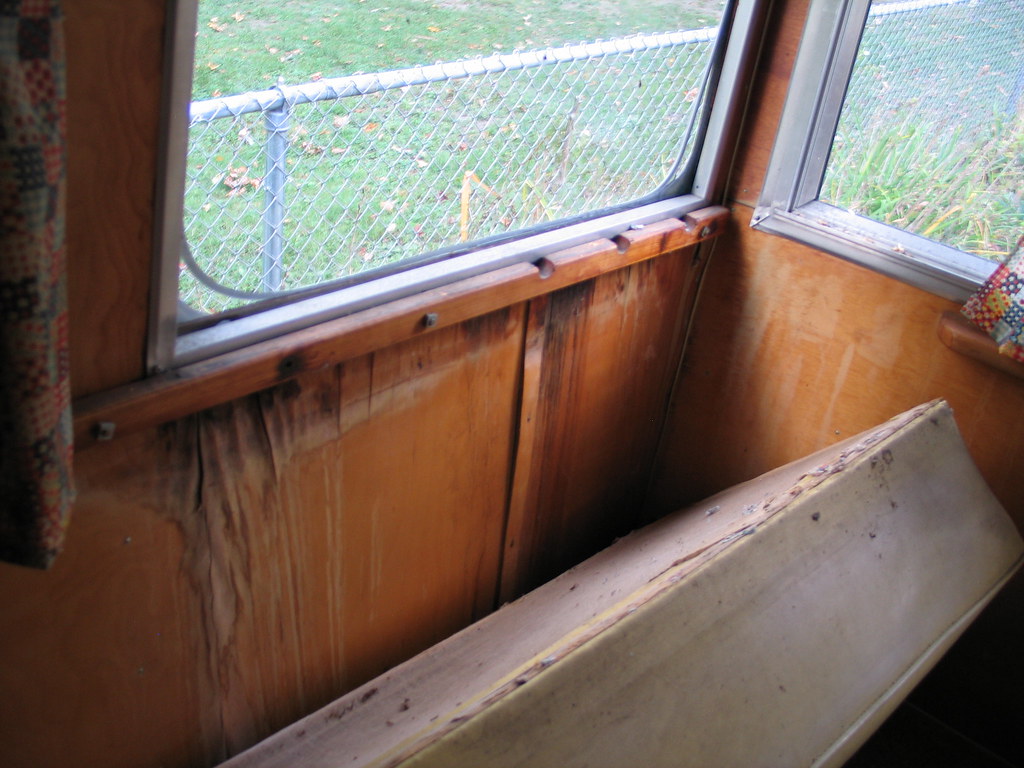
Failed window seals are a significant source of RV water damage, and the damage often starts long before the window itself becomes obviously broken. Butyl tape hardens and separates from the wall over time, UV degrades caulk at the exterior seam, and small gaps admit water that tracks behind the interior wall panel.
By the time you notice discoloration around a window frame or a soft spot in the wall below a window sill, water has typically been present for at least a season. The water damage repair guide covers what happens when water gets behind the skin. What starts as a $150–$200 window reseal job can escalate to $500–$2,500 in wall repair once the insulation and substrate get into the cost picture.
The preventive step is the same one that applies to roof penetrations: inspect the exterior sealant line around every window once a year. Lap sealant that has pulled away from the frame or shows cracks is telling you something. A tube of Dicor and 20 minutes per window is the maintenance version of this repair.
Sourcing replacement windows
The main challenge with RV window replacement is finding the right part. RV window sizes are not standardized the way residential windows are. Manufacturers use dozens of different frame profiles, opening dimensions, and corner radii.
The starting point is measuring the rough opening (the hole in the wall, not the window frame). Most suppliers sell by rough-opening dimension. RecPro, Specialty Recreation, and Hehr all publish fitment guides and have customer service lines that can match a measurement to an assembly.
For discontinued assemblies, custom glass-only replacement is often the practical solution. A local glass shop can cut single-pane glass to any rectangular dimension. For curved or radius glass, specialty RV glass shops like Wise RV Glass handle custom orders.
If you still have the RV’s build documentation, the window part number is usually in the service manual or listed on a build sheet inside a cabinet door. That number will match directly to the OEM supplier, which is usually Hehr, Specialty Recreation, or Lippert/Duncan Systems for most American-made coaches.
What insurance actually covers
Comprehensive RV insurance pays for windows broken by a sudden covered event: a stone kick-up on the highway, vandalism, hail, or a branch. You pay your deductible; the policy covers the rest. Most policies cover the cost of a matching replacement window, though older units with non-standard dimensions sometimes get actual-cash-value (depreciated) payouts that fall short of replacement cost.
What comprehensive does not cover: seal failure, fogging from age, frame rot from slow leaks, or any window failure the insurer can attribute to gradual wear or deferred maintenance. If you report a cracked window without a specific incident and the frame shows signs of long-term water tracking, expect the adjuster to look carefully. If a window did break during travel and the cause is traceable, a rock strike, a branch, a storm, photograph the damage before you touch anything. That documentation is what turns a claim into an approved claim.
For windshield-specific coverage, that is handled as a separate item on many policies. The windshield replacement cost guide covers how that pricing and coverage works. And the warranty and insurance overview walks through which repairs are worth pursuing as a claim versus paying out of pocket given deductible math.
Roof sealant failure around a window opening is a maintenance issue. The roof resealing guide covers what proper preventive resealing of every penetration and seam costs and why it prevents a much larger bill later.
Getting the right quote
Before calling shops, know three things: the window’s rough opening dimensions, whether you want glass-only or full assembly, and whether the surrounding frame and wall are solid. Shops quote faster and more accurately with that information.
Ask the shop to confirm the flat-rate hours for the job before authorizing work. RV shops bill flat rate rather than actual time, so a window that a technician completes in 90 minutes still bills at the 2-hour book rate. Knowing the book time tells you the labor ceiling before you approve anything.
Get quotes from at least two shops. Labor rates across the interior repair category vary enough that a $350 quote at an independent shop and a $700 quote at a Camping World service center can both be for the same 2-hour job, just at $175 versus $225 per hour.
What drives the price
| Cost factor | How it moves the price |
|---|---|
| Window type | A basic jalousie or single-pane slider costs $115–$190 in parts. A frameless radius window or large thermopane assembly runs $250–$600 in parts before any labor. Egress windows start around $230 for parts and $600–$1,500 installed because of their size and safety-compliance requirements. |
| Glass-only vs. full assembly | If the frame is intact, sourcing a cut-to-size glass pane from a specialist like Wise RV Glass or Lippert/Duncan Systems costs $80–$200 for standard single-pane glass and $150–$400 for a dual-pane IGU. Full assembly replacement includes the frame, hardware, and screen but costs two to three times more. |
| Dual-pane foggy seal failure | A fogged dual-pane window usually means the inter-pane seal has failed. A DIY reseal kit runs $125–$175 and handles roughly 10 windows. Professional remove-reseal-reinstall costs $200–$300 per window. If the glass itself is etched from long-term moisture exposure, full replacement is the only fix. |
| Window size | RecPro slider prices range from $115 for a 12x18-inch unit to $190 for a 30x20-inch panel. Frameless windows run $165 to $260 in the same size spread. Large or custom dimensions add $50–$200 over catalog pricing. |
| RV technician labor rates | Shop rates for RV service centers range from $159 at independent shops to $225–$275 at Camping World and General RV. A simple pop-in side window takes 1–2 hours; a flush-mount frameless or egress window takes 2–4 hours. Effective labor per window: $165–$550 depending on shop and window type. |
| Frame or seal damage | A window that failed because the surrounding frame is soft or the butyl tape seal has been leaking long-term may involve substrate repair before the new window goes in. If water tracked behind the old frame, expect $200–$800 in additional work before the replacement window is sealed. |
| Custom or discontinued sizes | Older coaches or uncommon profiles may have no catalog match. Custom-cut glass from a local shop costs $150–$400 per pane. Custom-fabricated frames for non-standard radius or corner profiles can run $400–$900 for the unit alone. |
DIY or hire a pro?
- Cost
- $80–$350 in parts and materials
- Time
- 2–4 hours per window
- Skill
- Beginner to Intermediate
Most RV side windows are owner-replaceable. The standard procedure is to remove a few screws from the exterior trim ring, pull the old assembly out, clean the frame channel, apply a fresh butyl tape bead, and press the new unit in from the outside. No welding, no special tools, no licensed trades involved. RecPro, Hehr, and Specialty Recreation publish replacement guides for their assemblies. Dual-pane foggy-seal repair is also a reasonable DIY project with a reseal kit if the glass is not etched. DIY gets harder with frameless flush-mount windows (more sealant work, more margin for a visible gap), egress windows (safety-compliance stakes), and any window where the surrounding structure is soft or water-damaged.
What you'll need
- Butyl tape (3/16-inch, bulk roll)
- Self-leveling lap sealant (Dicor or equivalent) (affiliate)
- Dual-pane window reseal kit
As an Amazon Associate, we earn from qualifying purchases.
- Cost
- $350–$1,500 depending on window type and shop rates
- Time
- 1–2 shop days plus scheduling (often 1–3 weeks out)
- Booking
- Call at least two shops; get labor time in writing
Professional installation makes sense for egress windows (safety-critical function must be reliable), for frameless flush-mount windows where a bad seal causes an immediate water-intrusion problem, and for any window where the surrounding wall or frame shows soft spots or rot. A shop will also source the window for you, which matters when the original part is discontinued or requires measurement. Get the labor estimate in flat-rate hours before authorizing work, shops vary widely.
Will insurance or a warranty cover it?
- RV insurance may cover this when the cause is a covered peril (storm, collision, fallen tree), not gradual wear or neglect.
- This is usually out of pocket. Standard policies treat it as wear and maintenance. A service contract bought before it fails is the main way to shift the risk.
Comprehensive RV insurance covers window breakage from a covered peril (stone strike, vandalism, storm impact) after your deductible. Gradual seal failure, fogging from age, and maintenance-deferred frame rot are not covered. A cracked windshield is handled separately under glass coverage on some policies; side windows typically fall under the same comprehensive provision.
Coverage depends on your policy and the cause of damage. Confirm specifics with your provider.