RV Toilet Replacement Cost: What to Expect in 2026
RV toilet replacement costs $20 to $90 for a seal or valve repair kit, $100 to $300 for a DIY gravity toilet swap, or $960 to $2,000 for a composting toilet upgrade. Here's what drives the range.
Typical cost
$20–$2,000
Seal, valve, and vacuum breaker repairs run $20-$90 in parts; a full gravity toilet swap costs $100-$300 DIY or $250-$550 installed; a composting toilet upgrade runs $960-$2,000 depending on who installs it
Most people pay around
$300
Costs verified July 2026
An RV toilet seal or valve repair costs $20 to $90 in parts. A full gravity toilet swap runs $100 to $300 if you do it yourself, or $250 to $550 with a mobile tech. Switching to a composting toilet is a bigger jump, $960 to $2,000 depending on whether you handle the venting and wiring yourself or pay someone to do it right. The toilet itself is rarely the expensive part. What you’re actually paying for is whichever tier of bowl you want, and whether you’re doing plumbing work or electrical work to put it in.
Why “RV toilet cost” covers such a wide range
Ask three RV owners what their toilet cost and you’ll get three different answers, mostly because “replace the toilet” means different things depending on what actually broke. Someone whose flush mechanism seized up spent $21 on a Thetford waste ball seal. Someone whose 12-year-old unit finally cracked at the base spent $200 on a new Dometic 300 series. Someone who got tired of the water tank and switched to composting spent over a thousand dollars on a Nature’s Head, plus a Saturday running vent hose through the roof.
None of them are wrong about what “toilet replacement” cost them. They just started from different problems.
What a repair actually costs before you buy a new toilet
Most toilet complaints aren’t toilet-replacement problems. They’re a $20-$60 part problem wearing a bigger costume.
| Failure | Part | Part Cost |
|---|---|---|
| Flush ball won’t seal, slow leak into the bowl | Thetford waste ball seal | $21 |
| Bowl doesn’t hold water between uses (Dometic) | Dometic flush ball seal kit | $41 |
| Weak or no water fill on flush | Dometic water valve kit (300/400 series) | $60 |
| Weak or no water fill (110/210/510 series) | Dometic water valve kit | $45 |
| Water trickles or gurgles after flushing stops | Vacuum breaker | $15-$73 |
| Foot pedal or hand-lever mechanism feels loose or sticks | Thetford Bravura mechanism repair kit | $33 |
The vacuum breaker range is wide on purpose. A generic aftermarket one runs as little as $15; the Dometic OEM version runs $36-$73 depending on whether it includes a hand-sprayer hookup. Either one fixes the same symptom, so buy generic unless you specifically want factory parts.
If the part costs $20-$60 and the toilet is otherwise sound, fix the part. A cracked bowl, a base that won’t stay sealed to the floor no matter how many times you replace the gasket, or a unit old enough that parts are getting hard to find, that’s when a full swap makes more sense.
Dometic vs. Thetford: what a new gravity toilet actually costs
The two brands dominate the RV toilet market, and pricing between them overlaps more than the brand loyalty in RV forums suggests.
| Model | Brand | Bowl | Typical price |
|---|---|---|---|
| 300 Series | Dometic | Round | $200 |
| 320 Series (sale) | Dometic | Elongated ceramic | $100 |
| 320 Series (retail) | Dometic | Elongated ceramic | $360 |
| 410/411 | Dometic | Round | $256-$301 |
| 510 | Dometic | Elongated, pressurized flush | $717 |
| Aqua-Magic VI | Thetford | Round, high profile | $156 |
| Aqua-Magic Residence | Thetford | Elongated, wood seat, high profile | $191 |
That $260 spread on the Dometic 320 between its sale price and full retail is the single biggest thing to watch for. The exact same model, sold by two different retailers, can be $100 apart, so it’s worth a five-minute price check across two or three sellers before buying either brand at sticker price.
Nearly every gravity toilet from either brand bolts to the same industry-standard floor flange spacing, so a Thetford can replace a Dometic and vice versa without modifying the floor. The exception shows up at dealerships, where service departments sometimes push a manufacturer-specific “approved” toilet that costs far more than an equivalent aftermarket unit for no functional reason. One owner on the Good Sam Community forum was quoted $700 for a toilet on a Fleetwood motorhome after being told it was a “special” part that had to be ordered from the manufacturer, despite the toilet looking and working exactly like every other one they’d owned. It probably wasn’t special. It was just the only option the dealer offered.
Composting toilets: what a Nature’s Head actually costs
Composting toilets have gone from van-life novelty to a legitimate option a lot of boondockers actually run, and the economics are different enough from a gravity toilet that they deserve their own math.
A Nature’s Head, the composting toilet with the largest install base in the RV and marine world, runs about $1,035 for the unit itself, including its spider-handle agitator and the small hardware needed to mount it. That’s four to five times what a mid-tier gravity toilet costs before you’ve bought a single vent hose.
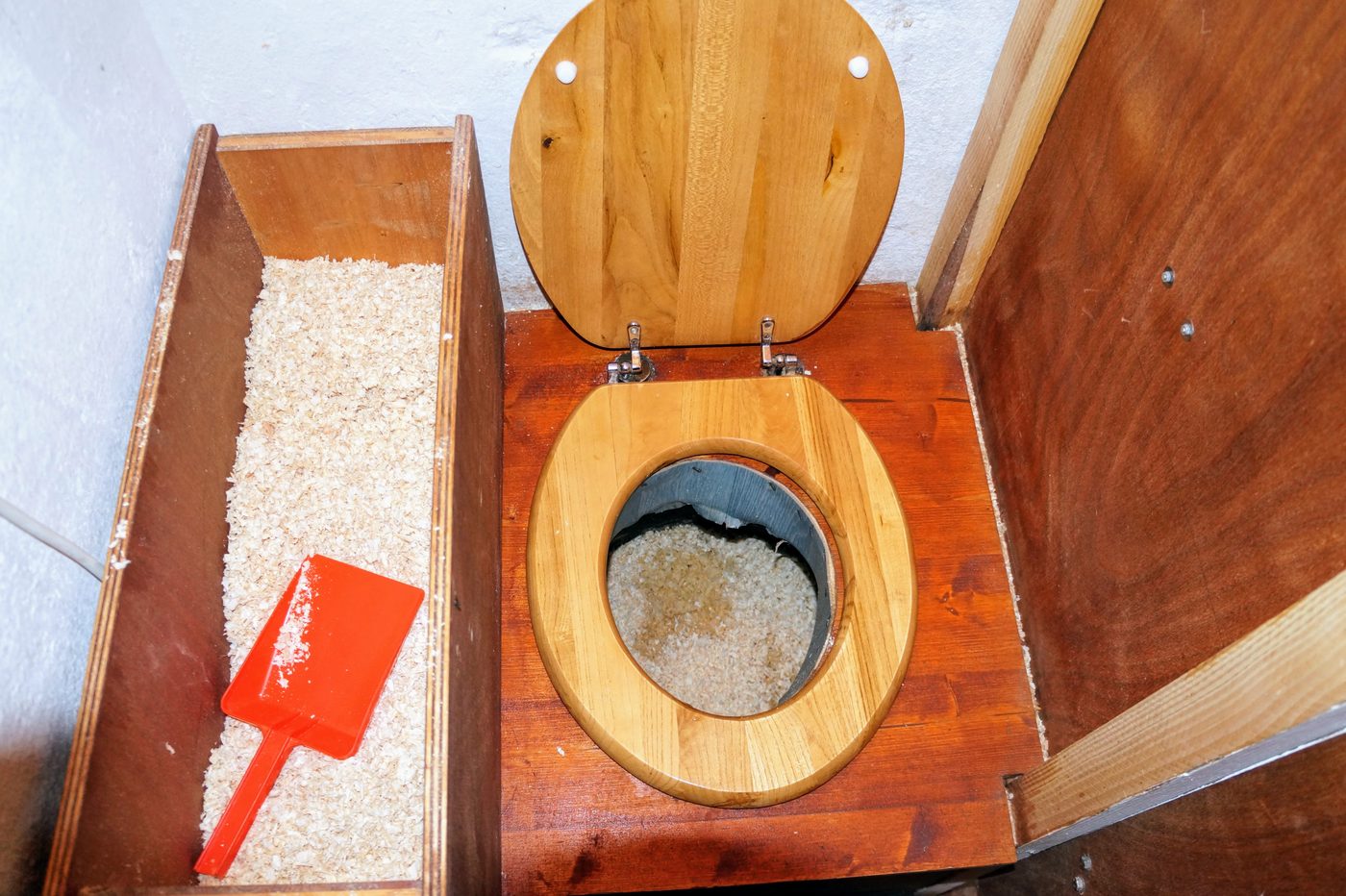
What you’re buying with that price is no black tank dependency at all. Solids and liquids separate inside the unit, liquids go into a small jug you empty at any regular restroom, and solids compost down with a peat moss or coconut coir medium you turn with a crank handle every few uses. No flush water, no black tank sensor lying to you, no dump station required for the solid side.
The tradeoff is installation complexity. You still need a 12V fan running continuously to vent moisture and odor outside the rig, which means a wired circuit and a roof or wall penetration for the vent hose, neither of which a gravity toilet requires. Some rigs also need a small riser built to match the composting unit’s height and footprint to the old toilet’s floor cutout, since composting toilets don’t share the gravity-toilet bolt pattern. Budget for a full weekend if you’re doing it yourself, longer if the vent run is awkward.
What professional installation costs
For a standard gravity toilet, the labor gap between DIY and professional is smaller than you’d expect, mostly because the job itself is so quick. Mobile RV Guy publishes a flat $179 for toilet removal and reinstallation labor alone, not counting the toilet. General mobile RV tech rates run $100 to $195 an hour depending on region, West Coast and Northeast shops run the high end, Midwest and South run lower, plus a $75-$200 trip charge just to show up. Since most techs can knock out a same-brand swap in well under an hour, total professional cost for parts and labor on a standard toilet usually lands in the $250-$550 range.

The math changes fast once “special order” enters the conversation. That $700 Fleetwood quote from the Good Sam Community thread wasn’t $700 in labor, it was a marked-up part sold as the only compatible option. Before paying dealer prices for a “manufacturer-specific” toilet, check whether a standard Dometic or Thetford unit fits the same floor flange, which it almost always does.
Composting toilet installs are where professional labor earns its cost more clearly. Correct 12V wiring on a switched circuit, a properly sealed vent penetration through the roof or wall, and getting the fan’s airflow dialed in so the unit actually stays odor-free are all things worth paying a tech to get right the first time, especially on a rig you don’t want to drill into twice.
Can you replace an RV toilet yourself?
For a standard gravity toilet, yes, and it’s genuinely one of the easier big jobs in an RV. As one DIY guide puts it, the whole unit is “only held in place with 2 bolts.” Turn off the water supply, whether that’s the pump or a city water connection, disconnect the water line fitting at the base of the toilet, pull the two floor bolts (sometimes capped with plastic covers you’ll need to pop off first), and the old toilet lifts straight off. Set the new unit on a fresh wax-free seal, bolt it down, reconnect the water line, and test for leaks before calling it done. Most owners are done in under an hour, and the parts savings alone usually justify the time: paying a shop to remove and reinstall an old toilet can cost more than the price of buying a new one outright.
Composting toilet installation is a different animal. There’s no propane and no water line to worry about, which removes some risk, but you’re adding 12V wiring and a vent penetration that a gravity toilet never needed. If you’re comfortable running low-voltage wire and sealing a roof or wall hole properly, it’s a doable weekend project. If either of those makes you nervous, that’s exactly the scope where paying for install makes sense.
Does insurance or an extended warranty cover a toilet?
Mechanical breakdown coverage under most RV extended warranty contracts covers the toilet’s water valve, vacuum breaker, and flush mechanism when the failure is a genuine defect, the same category other plumbing components fall into. What it typically excludes: a cracked ceramic bowl from impact, mineral scale buildup, or ordinary wear on a seal after years of use. Check the extended warranty cost guide for how these contracts define covered plumbing components more broadly.
Composting toilets sit outside that coverage almost universally, since they’re aftermarket additions on essentially every RV that has one rather than something the manufacturer installed. Standard RV insurance treats a composting toilet the same way it treats any other aftermarket upgrade: it’s excluded by default unless you specifically schedule it, which is worth doing given a Nature’s Head alone runs over a thousand dollars.
How toilet cost compares to other RV bathroom systems
A toilet repair or swap sits near the cheap end of RV bathroom work. The shower replacement guide covers a job that starts around the same $30-$100 range for a valve-only fix but climbs well past $1,000 once a pan or full surround is involved, since shower work usually means removing bonded wall panels that a toilet swap never touches. The water heater replacement guide runs a similar range to a mid-tier gravity toilet on the low end, but a tankless upgrade there pushes past $2,000, tracking closely with what a full composting toilet conversion costs on this page.
If low water pressure or weak flushes are part of what’s driving a toilet complaint in the first place, the water pump replacement guide is worth a look before assuming the toilet itself is the problem.
What drives the price
| Cost factor | How it moves the price |
|---|---|
| Repair vs. full replacement | A Thetford waste ball seal runs $21, a Dometic flush ball seal kit runs $41, and a water valve kit for a Dometic 300 or 400 series toilet runs $60. Most 'my toilet is broken' complaints are one of these three parts, not a dead toilet. A full mechanism repair kit for a Thetford Bravura runs about $33. None of this requires a new bowl. |
| Gravity toilet tier | Entry-level round-bowl units like the Dometic 300 series run $200. Step up to an elongated ceramic bowl like the Dometic 320 and pricing spans $100 on sale to $360 at full retail depending on the seller. Higher-tier models like the Dometic 410/411 run $256-$301, and the premium Dometic 510 with a full elongated bowl and pressurized flush runs $717. Thetford's equivalents, the Aqua-Magic VI and Aqua-Magic Residence, run $156-$191. |
| Brand and bolt-pattern compatibility | Nearly every gravity RV toilet bolts to the same standardized floor flange, so a Thetford can usually replace a Dometic and vice versa without cutting anything. The exception is a dealer that insists on a manufacturer-specific 'approved' part, which is where a $700 toilet quote comes from even though the toilet itself looks and works like any other. |
| Composting toilet vs. gravity toilet | A Nature's Head composting toilet runs roughly $1,035 for the unit with its included spider handle and small accessories. There's no black tank plumbing to connect, which sounds like it should make installation cheaper, but you're trading plumbing work for a 12V fan, a vent hose routed through the roof or wall, and (on some installs) a new floor-bolt pattern since composting units don't share the gravity-toilet footprint. |
| DIY vs. professional labor | Mobile RV Guy quotes a flat $179 for toilet R&R labor alone, not counting the toilet itself. General mobile tech rates run $100-$195/hr with a $75-$200 trip fee layered on top. Since a same-style swap takes most owners under an hour, DIY saves real money here in a way it doesn't on jobs that take all day. |
| Special-order or 'dealer only' parts | A Good Sam Community thread has an owner quoted $700 for a toilet replacement on a Fleetwood motorhome, told it was a 'special' unit that had to come from the manufacturer, despite looking and functioning like any standard toilet. That premium is markup on the part, not extra labor, and it's usually avoidable by buying a compatible aftermarket unit instead of the dealer's house brand. |
| Compartment access and floor condition | A toilet set into a tight corner behind a door that barely clears the bowl adds time regardless of brand. Soft or water-damaged subfloor around the base, common on older units where a seal failed years before anyone noticed, turns a bolt-and-reconnect job into a floor repair job first. |
DIY or hire a pro?
- Cost
- $20-$300 in parts for most gravity toilet jobs, $960-$1,500 for a full composting toilet conversion
- Time
- 15-30 minutes for a seal or valve kit; well under an hour for a same-style toilet swap; a full day for a composting toilet's venting and wiring
- Skill
- Beginner for a gravity toilet. Intermediate for a composting toilet, mainly because of the fan wiring and vent routing
A gravity toilet is genuinely one of the easiest big-ticket swaps in an RV. Shut off the water pump or city water connection, disconnect the water line at the base, remove the two floor bolts (sometimes hidden under plastic caps), and the toilet lifts straight off its wax-free seal. Set the new toilet on a fresh seal, bolt it down, reconnect the water line, and test. A composting toilet is a different kind of job entirely: no plumbing, but you're cutting or adapting a vent path for the 12V fan, running wire to a switched circuit, and in many rigs building a small riser or shim to match the unit's height to the old gravity toilet's floor cutout.
What you'll need
- Dometic 320 Series Standard Height RV Toilet, elongated ceramic bowl
- Thetford Aqua-Magic VI RV Toilet, high profile (affiliate)
- Dometic Flush Ball Seal Kit for 300/400 Series toilets (affiliate)
- Nature's Head Self-Contained Composting Toilet (affiliate)
As an Amazon Associate, we earn from qualifying purchases.
- Cost
- $250-$550 installed for a standard gravity toilet, $1,300-$2,000+ for a professional composting toilet conversion
- Time
- Under an hour for a standard swap; half a day to a full day for composting toilet venting and 12V wiring
- Booking
- Worth paying for on a special-order or manufacturer-specific unit in a tight compartment, or any composting conversion that involves new wiring and roof or wall venting
For a standard swap, you're mostly paying for the trip and the hour, not the difficulty. A shop or mobile tech at $100-$195/hr plus a $75-$200 trip fee will still land in the $250-$550 range for parts and labor on a same-style unit, which is close to what the toilet itself costs. It's worth it if the compartment is cramped, if you'd rather not deal with the water line disconnect, or if the dealer is the only source for a manufacturer-specific part. A composting toilet conversion is the case where professional installation earns its keep: proper 12V wiring, a correctly sealed roof or wall vent penetration, and getting the fan's draw right so the unit actually stays odor-free.
Will insurance or a warranty cover it?
- An extended warranty or service contract may cover this if the failure is mechanical and the component is listed in your plan.
- This is usually out of pocket. Standard policies treat it as wear and maintenance. A service contract bought before it fails is the main way to shift the risk.
Mechanical breakdown coverage under an RV extended warranty typically covers the toilet's water valve, vacuum breaker, and flush mechanism when the failure is a genuine defect, the same logic that applies to other plumbing components. What it almost never covers: a cracked ceramic bowl from impact, mineral buildup from hard water, or general wear on the seal from age. Composting toilets are aftermarket add-ons on virtually every rig, which puts them outside mechanical breakdown coverage entirely, the same treatment solar and other bolt-on upgrades get. Standard RV insurance follows the same pattern: it treats an aftermarket composting toilet as an upgrade to schedule separately, not a factory component it already accounts for.
Coverage depends on your policy and the cause of damage. Confirm specifics with your provider.