RV Awning Replacement Cost: What to Expect in 2026
RV awning replacement costs $200 to $3,000. Fabric-only swaps run $200-$750; a full electric assembly with a new motor runs $1,200-$3,000 installed.

Typical cost
$150–$3,000
Fabric-only replacement runs $200-$750; a full manual assembly costs $500-$1,800 installed, and a full electric assembly with a new motor runs $1,200-$3,000
Most people pay around
$850
Costs verified July 2026
Replacing RV awning fabric costs $150 to $750 in materials, or $400 to $900 with professional installation. A full assembly, arms, roller tube, and fabric together, runs $500 to $1,800 installed for a manual awning, or $1,200 to $3,000 for a full electric assembly with a new motor. Most failures are the fabric, not the hardware underneath it, which is the good news for your wallet.
Why RV awning costs vary so much
The single biggest cost driver is whether you actually need a new fabric panel or a whole new assembly. Awning arms and roller tubes are aluminum and mechanically simple; they rarely fail on their own. Fabric is vinyl or acrylic cloth stretched across a roller and exposed to full sun for months at a time, and it’s the part that actually wears out. Most vinyl and acrylic fabric holds up 8 to 12 years under normal seasonal use before UV exposure makes the material brittle enough to crack or tear on its own; full-timers parked in sunny climates year-round tend to see that timeline shorten. If the arms swing freely and the hardware still latches, you’re looking at a fabric-only job most of the time, not a full replacement.
Material choice is the second lever. Vinyl is fully waterproof and the more common choice; a 20-foot Carefree vinyl panel runs about $500 on sale, $600 at regular price. Acrylic costs more, $150 to $750 depending on length, but it breathes, which cuts down on mildew and the oven effect underneath the awning on a hot afternoon. The tradeoff: acrylic isn’t waterproof on its own, so it needs to come in before rain or be paired with a separate rain gutter accessory.
Fabric-only vs. full assembly: what each repair actually costs
Most RV owners don’t need to replace the whole awning. The table below breaks down when fabric-only makes sense and when it doesn’t.
| Situation | Typical Cost | Repair or Full Replace? |
|---|---|---|
| Fabric torn, sun-brittle, or badly faded; arms and roller intact | $150-$900 | Fabric-only |
| End cap cracked or a single arm spring failed | $100-$350 | Hardware repair |
| Roller tube bent or dented from a wind event | $300-$800 | Depends on severity; often repair |
| Fabric shredded AND arms bent in the same storm | $800-$2,000+ | Full assembly |
| Electric motor dead, fabric and arms fine | $300-$800 | Motor-only repair |
| Manual awning being upgraded to electric | $1,200-$3,000 | Full assembly, new category |
| Awning over 15 years old, multiple prior repairs | Varies | Often full replace |
The math almost always favors fabric-only when that’s all that’s actually damaged. A $500 fabric swap versus a $1,500 full assembly is not a close call, and swapping the whole unit doesn’t buy you anything extra if the hardware was fine to begin with.
What new awning fabric costs by size and material
Fabric pricing scales close to linearly with length once you’re past the smallest sizes, since the material itself is the main cost, not the manufacturing. Here’s what that looks like using real current retail pricing:
- 8-10 ft (truck campers, small trailers): $150-$250 vinyl, $200-$350 acrylic
- 12-16 ft (mid-size travel trailers): $250-$400 vinyl, $350-$550 acrylic
- 18-20 ft (larger trailers, fifth wheels): $400-$600 vinyl, $500-$750 acrylic
- 21 ft+ (large fifth wheels, Class A patio awnings): $500-$750+ vinyl, up to $750+ acrylic
A specific real example: Carefree’s 20-foot vinyl replacement fabric with an integrated LED weatherguard strip lists at $599.99 and was on sale for $499.99 at the time of writing. Fabric panels like that one, with the LED strip built into the valance, are a common upgrade when you’re already replacing the fabric: the light gets wired in during the same job instead of becoming a separate project later, for a modest bump over the base fabric price. Solera’s universal vinyl fabric, which fits Dometic, Carefree, and A&E awnings without an aluminum weather shield, is sold in the same 10-21 foot range and works as a lower-cost alternative to a brand-matched panel when your existing hardware doesn’t require proprietary fabric. The one exception is Solera’s own 2000 Series awning, which the universal fabric doesn’t fit; check your model against Solera’s compatibility list before ordering if you’re not sure which shield type you have.

Manual vs. electric: the motor question
An electric awning extends and retracts at the push of a button off the RV’s 12V system, and it costs more at every stage: more to buy new, more to repair when the motor fails, and more to upgrade into if you’re currently running a manual crank arm. A manual-to-electric conversion, or a straight motor replacement on an already-electric unit, runs $300 to $500 in additional labor on top of parts, mostly because of the wiring run back to a switched circuit.
Whether it’s worth it depends on how you actually use the awning. If you’re setting up and tearing down a manual awning daily as a full-timer, the button convenience earns its keep fast. If you deploy the awning three times a summer, a manual setup that costs less to buy and has one less thing to fail is the more sensible choice.
Wind and storm damage: the most common awning claim
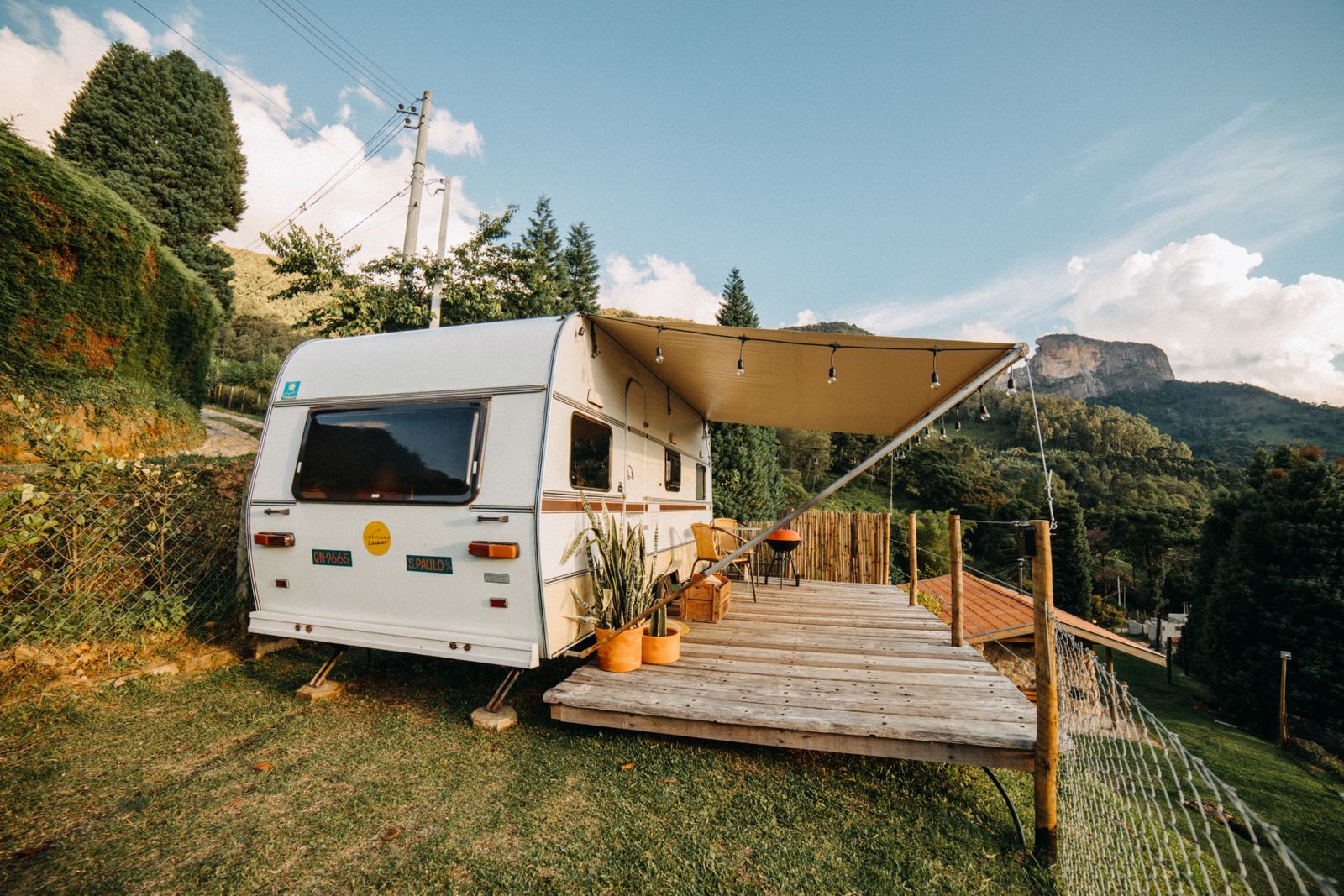
Wind is the leading cause of catastrophic awning damage, not slow UV wear. A gust catches an extended fabric panel like a sail, and the arms bend or the fabric tears clean through before anyone can retract it. This is also the scenario most likely to be covered by insurance rather than paid out of pocket.
Comprehensive RV insurance typically pays for awning damage from wind, hail, or a falling branch, the same category of claim as storm damage anywhere else on the rig, minus your deductible. The exclusion that trips people up is neglect: insurers routinely deny a claim when the awning was left extended during a forecasted storm, since retracting it in bad weather is treated as a basic maintenance expectation, not optional. If a storm is coming and the awning is out, crank it in. It’s the cheapest insurance move available and it costs nothing.
Can you replace RV awning fabric yourself?
For a fabric-only swap on a manual awning, yes, and plenty of owners do it in an afternoon. Extend the awning fully, pull the end caps off the roller tube, and slide the old fabric out lengthwise through the roller-tube channel and the awning rail mounted to the RV’s side wall. The new fabric threads back through the same two channels in reverse. A second person helping feed the fabric while you pull makes this considerably easier and reduces the risk of creasing the new panel.
The two things that actually go wrong on a DIY job: ordering a fabric whose bead profile doesn’t match your existing rail (measure the channel before you order, don’t guess from the brand name alone), and rolling the new fabric up unevenly, which sets in as a permanent crease within a season. A full electric assembly swap is a different level of work entirely, involving motor wiring and calibration, and it’s where most owners are better off paying for the labor.
How awning cost compares to other RV exterior repairs
Awning work sits at the lower end of RV exterior repair costs when it’s fabric-only, and climbs into full-system territory only when a storm takes out the arms along with the fabric. For other exterior mechanical components with a similar wear-and-tear profile, the slide-out repair guide covers a comparable category of moving hardware that takes weather damage over time.
For the coverage question that comes up on almost every storm-related repair, what RV extended warranties actually cover walks through contract tiers and where mechanical breakdown coverage stops and wear-and-tear exclusions start.
What drives the price
| Cost factor | How it moves the price |
|---|---|
| Fabric-only vs. full assembly replacement | Fabric alone runs $150-$750 depending on size and material. A full assembly, arms, roller tube, and fabric together, runs $500-$2,500 in parts before labor. If the arms and roller tube are straight and the hardware still latches cleanly, replacing just the fabric is almost always the right call financially. |
| Material: vinyl vs. acrylic | Vinyl fabric runs $100-$600 and is fully waterproof, the standard choice for most patio awnings. Acrylic runs $150-$750, breathes better so it resists mildew and cuts heat buildup underneath, but needs a separate rain gutter or has to be rolled up before a downpour since it isn't waterproof on its own. |
| Awning length | A 20-foot Carefree vinyl replacement panel runs about $500 on sale ($600 regular). Shorter 8-10 foot fabrics for smaller trailers and truck campers run $150-$250. Length scales roughly linearly with price once you're past the smallest sizes, since it's mostly a function of material yardage. |
| Manual vs. electric (motorized) | A manual-to-electric upgrade, or replacing a failed motor on an existing electric awning, adds $300-$500 in labor on top of parts, largely because of the 12V wiring run back to the RV's electrical system. A full electric assembly installed runs $1,200-$3,000 versus $500-$1,800 for the equivalent manual setup. |
| Brand and hardware compatibility | Universal replacement fabrics from Solera fit Dometic, Carefree, and A&E awnings without an aluminum weather shield, which keeps fabric-only jobs simple across brands. Full assembly hardware is more brand-specific: rafter arms, end caps, and integrated LED light strips from one manufacturer don't always bolt onto another brand's roller tube without an adapter kit. |
| Cause of failure: wind and storm tears vs. UV wear | A fabric shredded in a wind event is a different repair decision than one that's simply sun-brittle after 10 years. The first is often an insurance claim. The second is a maintenance replacement you're paying for out of pocket, and it's the more common of the two by a wide margin. |
| Labor rate and crew size | Shop labor for awning work runs $75-$150 an hour. One iRV2 owner reported $433 total for fabric removal and reinstallation, done by two techs in about an hour, roughly $200/hour split between them. A full electric assembly swap takes closer to half a day. |
DIY or hire a pro?
- Cost
- $150-$750 in fabric for a fabric-only swap
- Time
- 2-4 hours alone, faster with a second set of hands
- Skill
- Moderate
Replacing fabric on a manual awning is a realistic weekend job. Extend the awning fully, remove the end caps, and slide the old fabric out of the roller-tube channel and the awning rail on the RV's side wall, usually by pulling it lengthwise while a helper feeds slack. Thread the new fabric in the reverse order, making sure the bead on the fabric's edge seats fully in both channels before you start rolling it back up. No electrical work is involved on a manual unit. The parts that go wrong: forcing a fabric with the wrong bead profile into the rail (measure your existing rail before ordering), and rolling the new fabric up crooked, which telegraphs into permanent creasing within a season.
What you'll need
- Heavy-duty vinyl replacement awning fabric, 13 ft (compatible with Dometic, Carefree, and Solera) (affiliate)
- Awning fabric puller tool (affiliate)
- Replacement end caps or rafter arm hardware kit
As an Amazon Associate, we earn from qualifying purchases.
- Cost
- $400-$3,000 depending on scope
- Time
- About an hour for a straightforward fabric swap; half a day for a full electric assembly
- Booking
- Ladder work on a wet or windy day is where DIY jobs go sideways; a shop or mobile tech removes that variable
A shop's value on a fabric-only job is speed and a second set of hands, the same job an owner can do solo in an afternoon but two techs finish in an hour. The value goes up sharply on a full electric assembly: motor wiring has to tie into the RV's 12V system correctly, the arms need calibrating so the awning doesn't slam down on the switch limit, and any integrated LED strip needs its own wiring run. Get a written scope before authorizing a full assembly swap; "replace the awning" and "replace the awning and rewire the motor circuit" are very different invoices.
Will insurance or a warranty cover it?
- RV insurance may cover this when the cause is a covered peril (storm, collision, fallen tree), not gradual wear or neglect.
- An extended warranty or service contract may cover this if the failure is mechanical and the component is listed in your plan.
- This is usually out of pocket. Standard policies treat it as wear and maintenance. A service contract bought before it fails is the main way to shift the risk.
Comprehensive RV insurance typically covers awning damage from wind, hail, or a falling branch, the same category as storm damage to the rest of the rig, minus your deductible. The exclusion that catches owners is negligence: insurers routinely deny claims when the awning was left extended during high winds or a storm, since most policies expect you to retract it. Extended warranty mechanical-breakdown coverage can apply to a failed electric awning motor, but it does not cover UV-worn or torn fabric, which every contract treats as normal wear and tear.
Coverage depends on your policy and the cause of damage. Confirm specifics with your provider.